
![[Agriculture & Biodiversity][Natural Capital Forum Opening] “Biodiversity ESG Must Be Proven with Data, Not Just Goodwill”](https://thankscarbon.com/wp-content/uploads/2026/06/뉴스_자연자본.jpg)
[Agriculture & Biodiversity][Natural Capital Forum Opening] “Biodiversity ESG Must Be Proven with Data, Not Just Goodwill”
Keynote Focus: Great emphasis placed on 'On-Site Execution' and 'Data Acquisition'
2026-06-12Source: Energy Economic News / Translated for THANKS CARBON Archive
Corporate ESG (Environmental, Social, and Governance) frameworks are rapidly expanding beyond carbon-centric metrics to encompass comprehensive natural capital. As biodiversity management and standardized disclosure emerge as pivotal new imperatives, ESG is evolving past superficial declarations or marketing campaigns. Instead, it is actively restructuring business operational frameworks and global supply chains. Experts stress that corporate competitiveness is no longer determined by ‘how much a company claims to have done,’ but rather by ‘how robustly they can empirically prove it.’
On May 22nd, the “2026 Korea ESG Biodiversity and Natural Capital Forum”—jointly hosted by the Energy Economic News and the Korea Green Foundation—was held at the Korea Chamber of Commerce and Industry (KCCI) in Jung-gu, Seoul. The forum saw intensive discussions regarding practical challenges and actionable strategies surrounding biodiversity as it rises to become a foundational pillar of corporate ESG.
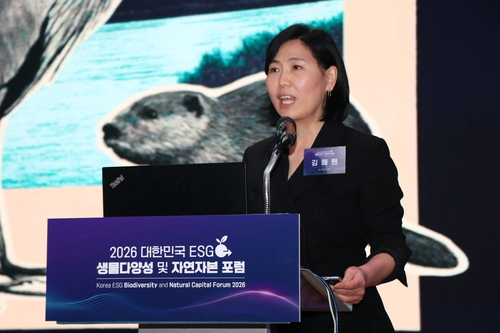
During the opening session, keynote speeches were delivered by Ki-young Park (Director of the Green CSR Center at the Korea Green Foundation), Hyeong-cheol Yeom (Co-representative of the Social Cooperative ‘Hangang’), and Hae-won Kim (CEO of THANKS CARBON). The speakers unanimously diagnosed that amid rapidly tightening global disclosure mandates and regulations, ‘on-site execution’ and ‘data acquisition’ have become the ultimate determining variables.
“The Era of Natural Capital Disclosure” … Corporate ESG Expands Its Horizons
Ki-young Park, Director of the Green CSR Center at the Korea Green Foundation, emphasized, “The global regulatory trajectory is moving decisively toward mandating corporations to disclose their risks and opportunities not only from a climate perspective but also from a natural capital standpoint.” Indeed, in recent global risk assessments, biodiversity loss and ecosystem collapse have been designated as top-tier global threats, accelerated by the imminent institutionalization of new compliance frameworks such as the TNFD (Taskforce on Nature-related Financial Disclosures).
“Reports Aren’t Enough” … The Practical Challenges of Space and Personnel on the Ground
Hyeong-cheol Yeom, Co-representative of the Social Cooperative ‘Hangang’, highlighted a grounded approach: “Biodiversity ESG is not a matter of paperwork; it is fundamentally about where, by whom, and how actions are executed on the ground.” Citing the Jungnangcheon Ecological Restoration Project as a primary baseline, he explained, “True restoration must begin from fundamental, localized efforts—such as waste collection, invasive species eradication, and preventing reckless dredging.”
Furthermore, in the ‘Saenggeo Jincheon Project’ currently being conducted in partnership with Hyundai Mobis and other corporate stakeholders, teams are working to revert rivers back to sand-based ecosystems specifically to revive endangered species. These efforts have already shown early success, with targeted species officially spotted returning to the habitat.
However, ecological restoration remains a long-term endeavor plagued by high uncertainty. Yeom pointed out structural hurdles, noting, “Even when you plant trees, roughly 30% naturally perish, and hard-earned ecological milestones can be wiped out instantly by sudden administrative shifts or commercial developments. This reality inherently clashes with the short-term, quarterly performance-driven structures typical of corporations.”
“Data is the Ultimate Answer” … Measuring Nature via AI and Satellites
Hae-won Kim, CEO of THANKS CARBON, strongly emphasized the absolute necessity of quantification: “Biodiversity ESG cannot rely on goodwill; it must be backed by verifiable, empirical data.” He observed that many corporations currently experience significant friction responding to disclosure regulations due to difficulties in establishing metrics, the absence of historical baselines, and a profound lack of foundational ecological data.
To bridge this gap, advanced technologies that measure ecosystem changes—such as satellite imagery, acoustic AI, and environmental DNA (eDNA)—are rapidly surfacing as viable solutions. Satellite data allows companies to track deforestation and water resource fluctuations across vast supply chains. Acoustic AI analyzes species diversity by identifying distinct bird and animal vocalizations within a given habitat. Meanwhile, eDNA analysis quantifies changes in biological species by testing the trace genetic footprints organisms naturally leave behind in their surrounding environment.
In particular, by structuring operations around the TNFD’s LEAP methodology (Locate-Evaluate-Assess-Prepare), corporations can systematically map out everything from operational boundaries to risk exposure and mitigation strategies, allowing them to remain agile against diverse international regulations. Kim concluded, “Ultimately, all global disclosures and compliance frameworks converge toward ‘location-based natural data acquisition.’ Just as human beings require regular medical check-ups to track health metrics, nature requires continuous, technological diagnostic assessments.”
“On-Site, Data, and Long-Term Investment” … The Three Pillars of Biodiversity ESG
Synthesizing the insights from the forum’s sessions, a company’s successful response to biodiversity ESG hinges on three interdependent factors: ‘on-site execution’ where real ecosystem restoration and stewardship occur, ‘data acquisition’ that allows these impacts to be accurately quantified and disclosed, and ‘long-term investment and partnerships’ that comfortably outlast short-term corporate performance cycles. As the paradigm shift from carbon-centric ESG to broader natural capital accelerates, global attention is now focusing on how effectively corporations can implement these structural requirements.
Source: Energy Economic News / Reporter Jeon Ji-Sung / jjs@ekn.kr
 Newsletter Subscribe


