
![[AI/Satellite & Drone/MRV Verification] Unverified Reductions Are Worth ‘0 Won’⋯ Thanks Carbon Breaks Through Carbon Market’s ‘Data Barrier’](https://thankscarbon.com/wp-content/uploads/2026/06/이미지에-alt-속성이-없음.jpeg)
[AI/Satellite & Drone/MRV Verification] Unverified Reductions Are Worth ‘0 Won’⋯ Thanks Carbon Breaks Through Carbon Market’s ‘Data Barrier’
* Focused on solving time and cost bottlenecks in rice farming methane reduction initiatives * Developed 'Haimdall', integrating satellite imagery with real-time field data * Planning expansion to measure forestry, blue carbon, and biodiversity impact
2026-08-09Source: Green Post Korea / Translated for THANKS CARBON Archive
Even standardizing 10-billion-won carbon reductions is worth 0 won without proof: Thanks Carbon ends MRV barriers with AI and satellites. No matter how many tens of billions of won are spent on reducing carbon emissions to save the planet, if those reductions cannot be verified, their financial value remains zero. Without precise, data-backed proof of actual reductions, issuing carbon credits or recovering investments becomes impossible. Particularly in sectors where project sites span vast areas and participants are widely dispersed, major climate projects have frequently stalled due to this high hurdle of verification.
Thanks Carbon, a climate tech company, has put an end to this costly verification dilemma using satellites and artificial intelligence (AI). The company has completely digitized the traditionally inefficient Measurement, Reporting, and Verification (MRV) process which previously relied on sending personnel directly to project sites to record data manually. By tracking large-scale reduction activities on the ground in real time via satellite, Thanks Carbon uses AI to automatically transform these tracking metrics into verified data that complies strictly with international standards.
At the core of this breakthrough is Haimdall, a digital MRV platform. Powered by unalterable, high-trust data generated by Haimdall, Thanks Carbon is accelerating the supply of digital MRV tools, capturing global carbon reduction projects along the way. Furthermore, the company is reshaping the carbon market landscape by establishing a financing ecosystem that allows reduction achievements to be monetized on the spot.

The Challenge: Proof Was Harder Than Reduction
Thanks Carbon initially focused on methane emissions generated during rice farming. When paddy fields remain continuously flooded, oxygen becomes depleted in the soil, generating significant amounts of methane. By periodically draining and refilling paddies within a range that does not harm rice growth farmers can substantially cut both methane emissions and water usage.
The key challenge lies in verifying whether farmers have properly executed this water management practice. Relying solely on manual farming logs and physical site visits to verify thousands of individual farms demands immense time and expense, making it nearly impossible to maintain data accuracy and consistency. As project footprints expand across multiple countries, the required personnel, time, and financial costs scale exponentially.
Haewon Kim, CEO of Thanks Carbon, remarked:
“While greenhouse gas reduction projects need to expand rapidly on a massive scale, local regulations and legacy technologies simply couldn’t keep pace. In rice farming methane reduction projects, the biggest obstacle was not achieving the reduction itself, but proving it.”
(omitted)
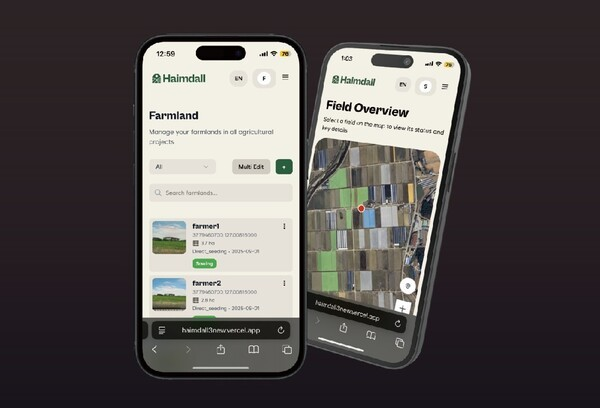
‘Haimdall’: The Digital MRV Powered by Field and Satellite Data
Haimdall manages carbon reduction projects by synthesizing satellite imagery, climate, soil, hydrological, and crop yield data, along with field inputs recorded directly by farmers. It analyzes field acreages and agricultural boundaries, utilizing radar satellite imagery and field data processed through AI to determine whether water management practices have been executed properly. By centralizing farmer registration records, location coordinates, field photos, agricultural logs, and satellite data, Haimdall provides a streamlined source of truth that simplifies reporting and verification for international certifying bodies.
In its early stage, Haimdall functioned primarily as a field management tool for tracking farmer activity. However, by adding critical capabilities required for live carbon projects and automating manual tasks via AI, it has evolved into an end-to-end management platform for large-scale carbon initiatives.
Haimdall connects Fieldsense which analyzes agricultural boundaries with Aquasight which monitors and verifies paddy water management practices while managing farm data and field/satellite assets in an integrated ecosystem. Thanks Carbon is continuously enhancing these capabilities: using AI to infer farm boundaries even in developing nations lacking digital map coordinates, and refining usability for elderly farmers working under unstable internet environments.
CEO Kim highlighted:
“Farmers worry about whether practicing new eco-friendly methods will yield tangible financial compensation, while project developers struggle to aggregate and certify data across thousands of smallholder farms. Meanwhile, corporate buyers need absolute certainty that the carbon credits they purchase are genuine. The common foundation required to solve the challenges of all three stakeholders is trusted, reliable data.”
Dual Strategy: Platform Supply and Project Development
Thanks Carbon operates a dual business model: developing carbon reduction projects directly while simultaneously licensing the Haimdall platform to external partners. When leading direct development projects, Thanks Carbon collaborates with local governments to secure project sites, train farmers, manage field operations, and collect data. The company also handles international certification processes and carbon credit issuance. Additionally, it licenses Haimdall to third-party project developers, government entities, and international organizations to help them manage their own reduction activities and verification data.
“Thanks Carbon is both a project developer and a platform provider,” Kim explained. “While directly developing and operating our own projects, we actively supply Haimdall to other developers, government agencies, and international organizations.”
This business architecture is designed to directly connect sustainable farming practices with demand in global carbon markets. Farmers earn financial rewards by proving their reduction activities through data; project operators oversee numerous farms and sites under a single unified system; and corporate credit buyers and certifying agencies can independently verify actual reduction performances using combined field logs and satellite records.
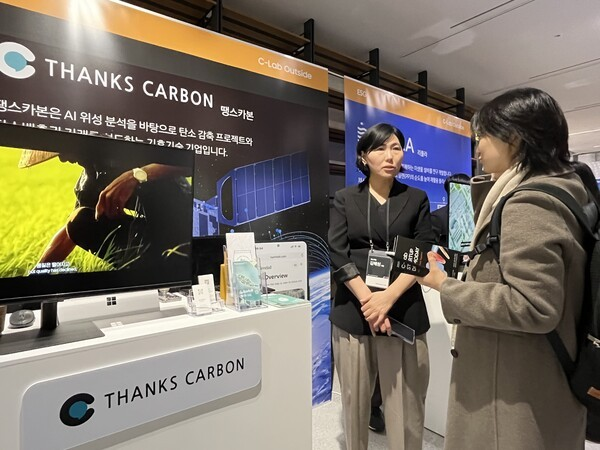
Technological Advancement & Investment Connections for Global Expansion
Thanks Carbon announced that it is actively advancing methane reduction projects in rice farming across countries such as Cambodia, Vietnam, and Bangladesh. Governments and farmers in these regions can manage the entire lifecycle, from contracting to reduction activities and verification, on a single platform. Concurrently, certifying bodies and corporate credit buyers can monitor live project progress through dedicated dashboards and automated reports.
Expanding initiatives across Southeast Asia requires not only local government and agricultural partnerships, but also robust project financing, certification pathways, and carbon credit sales networks. To support this growth, Thanks Carbon has been selected for a series of high-profile support and acceleration programs.
Recently, the company was named to the Ministry of SMEs and Startups’ ‘Super Gap Startup 1000+’ project and the Amazon Web Services (AWS) Jungle Program. Additionally, it was inducted into ‘KDB NextOne’ and ‘IBK Changgong,’ the premier startup incubation programs operated by Korea Development Bank and Industrial Bank of Korea, respectively. Thanks Carbon plans to leverage the Ministry and AWS programs to elevate its satellite data processing and AI capabilities, while utilizing support from KDB and IBK to broaden collaboration networks and attract investment.
Looking ahead, Thanks Carbon plans to adapt its data analytics framework, pioneered in rice farming methane reduction, to forestry, blue carbon, biodiversity, and natural capital management. The company aims to expand its measurement scope beyond carbon offset metrics to include broader ecological changes across corporate supply chains.
“Carbon is just our starting point,” stated CEO Kim. “Based on the AI and satellite technologies developed in Korea, we aim to grow into a global climate infrastructure company that measures and protects biodiversity and natural capital across global supply chains.”
Source: Green Post Korea / Translated for THANKS CARBON ArchiveReporter Ik-hoon Shin
 Newsletter Subscribe


